
The Piers of the Mornington Peninsula: A Macro Diver’s heaven

Everyone’s heard of the Great Barrier Reef, but a lot of divers may not know about the Great Southern Reef, which stretches for over 8,000 kilometers along the southern Australian coastline. While it may not be as well-known, it is a global hotspot for biodiversity, with estimates suggesting that up to 80% of species are endemic to the region. In fact, the number of endemic species on the Great Southern Reef actually outnumber those on the Great Barrier Reef! And crazily enough, I hadn’t actually ever heard of this reef system until a few years ago.
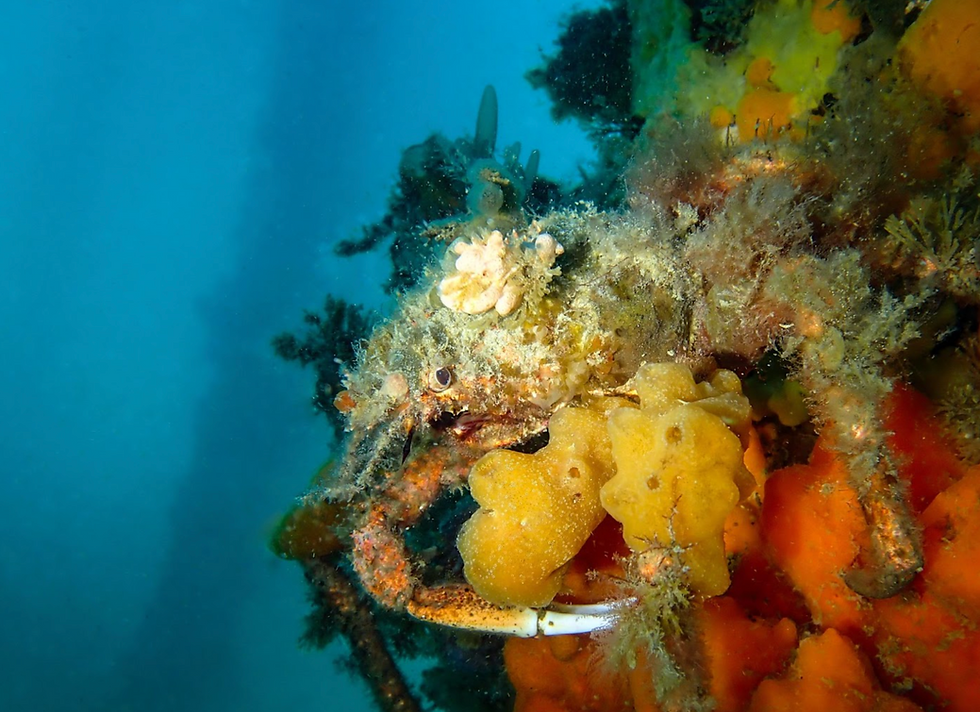
Port Phillip Bay in Victoria makes up just a small part of the GSR, and some of my most memorable dives have been down in these cold waters. Here, the cold, nutrient-rich waters allow delicate ecosystems to thrive. The colourful piers of the peninsula are a macro photographer’s wonderland, and the pylons are home to a number of incredibly photogenic creatures such as weedy seadragons, seahorses, cephalopods, decorator crabs, and of course, nudibranchs!
Despite growing up in Melbourne, for the first 25 years of my life I had never known all of these amazing creatures lived in my own backyard! So on my first dive under these piers, I was truly blown away. The dives were very easily accessed (we walked right off the beach) and while you may have to brave the colder water temperatures, I hope I can convince you that it’s most definitely worth a visit!
Meeting the Locals: The Weedy Seadragons
Hiding under the timber pylons of the Portsea Pier are the beautiful Weedy Seadragons. Weedy Seadragons (Phyllopteryx taeniolatus) are endemic to the southern Australian waters. They are close relatives of seahorses, but have additional leaf-life appendages. Unlike seahorses, a seadragons' tails cannot be used for gripping. They spend most of their time swaying in the weeds, relying on their camouflage and spines for protection.

Seahorses under the Pylons
Under the Rye pier, tucked in against pylons and hiding amongst the sponges, hide seahorses no larger than your hand. I actually swam right past this one, and would not have spotted it if not for my dive guide pointing it out!
A seahorse's curious eyes can move independently from one another. They use them to scan their surroundings for potential predators and prey. With their tiny curled tail, they often anchor themselves to a blade of seagrass and gently sway with the reeds in perfect camouflage.

An Octopus Den
My dive buddy managed to find a southern Gloomy Octopus (Octopus tetricus) hiding beneath the rocks. Gloomy Octopus like to collect the shells of their prey. This little one had a great collection scattered around his den as a means of extra defence.
You can tell when they look at you that these creatures have an intelligence beyond what we can comprehend. I'm not exaggerating when I say that after the dive, exiting the water and walking up the beach felt like we had just left another underwater realm!

Nudibranchs EVERYWHERE!
Then, of course, there are the nudibranchs. These tiny, colourful slugs are my favourite creatures of all! Also known as the Pokémon of the sea, there are over 3000 species of all different shapes, sizes and colours.
Since evolving from shelled ancestors, nudibranchs have ditched their shells and instead developed bright colour displays as a form of protection. Some species produce their own toxins, and some obtain their toxins from their diet. Others, in a biological phenomenon called "mimicry," simply pretend to be toxic to scare off predators with their bright colours. As such, nudibranchs do not have many predators, and are only at risk from other nudibranchs, turtles, some crabs and humans.


Conclusion
Photographing macro subjects is always a practice of patience. I often hover and wait for just the right moment as the seadragon or nudibranch positions itself in the perfect spot. Capturing these incredible creatures in the wild is a chance to inspire others to look closer. It’s a reminder that world-class dives are not only found in the remote tropics, but are also right underneath our local piers, where hundreds of people walk every day.
Want to Learn More?
If you’d like to learn more about underwater photography and editing, join me on a dive trip in 2026! This year I'll be heading to Raja Ampat, Komodo and Timor-Leste!
Send me a message or check out our website for more details! Instagram: @tianioceani | @dive_and_more
Email: contact@diveandmore.com


Canggu Silver Jewelry Class provides guided crafting opportunities. The format appears clear. It supports practical skill building.